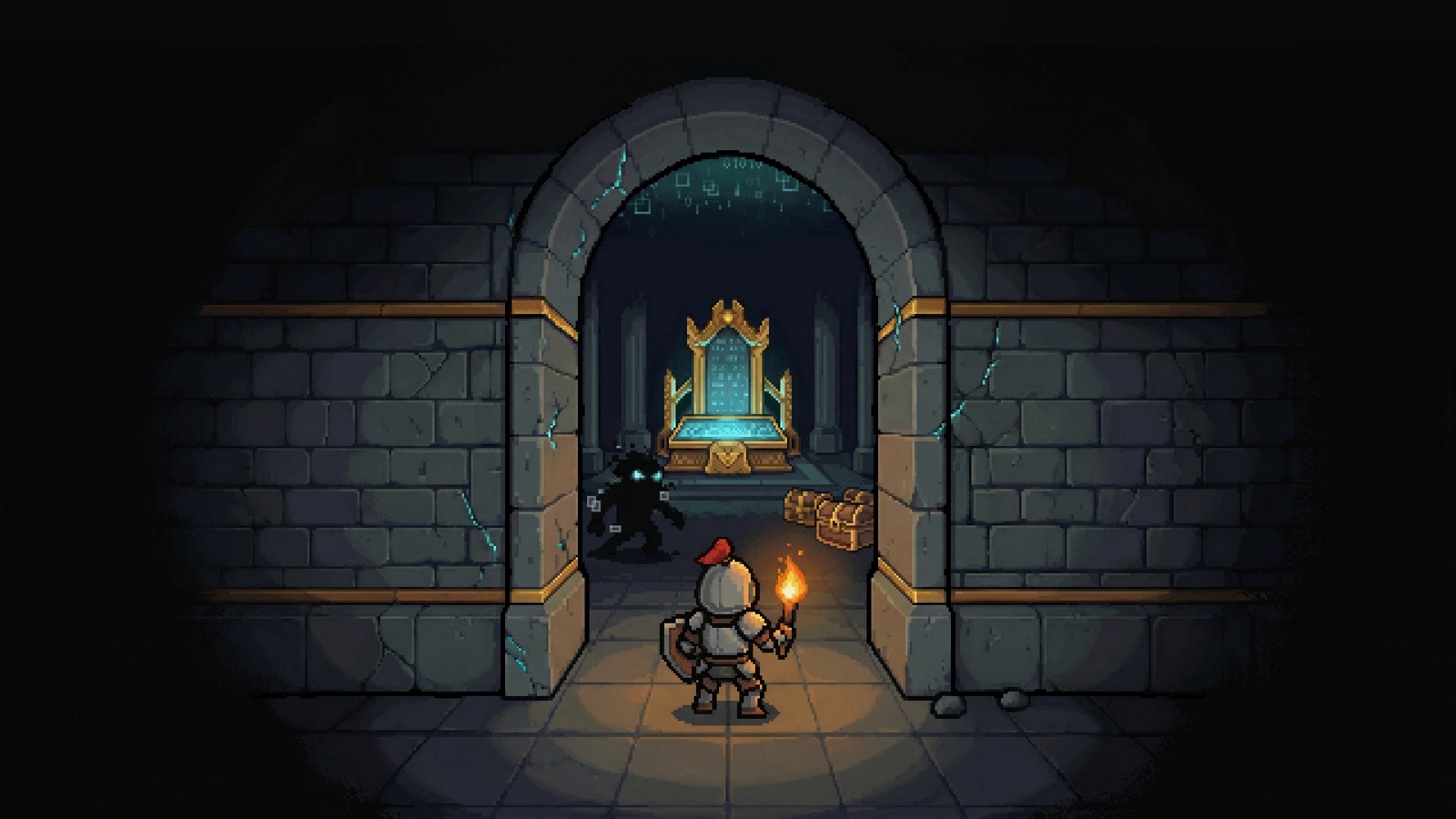
FrontispieceGilded Dungeon, the reference implementation. Every entrance fee paid in this room is split on chain the moment it is paid.
00
Abstract
Dungeoncoin ($DUNG) is a fixed-supply currency for games in which players compete for prize pools funded entirely by other players. All 100,000,000 DUNG are created once at deployment. No additional DUNG can ever be minted, including for gameplay rewards. A defined portion enters circulation through the initial public sale and liquidity. The remaining allocations are locked and released only under the binding schedule published before the sale. Initial sale proceeds fund the launch and an operating runway. The long-term objective is for Dungeon Labs to be funded by the published shares of games it develops, operates, or publishes.
This paper explains why game tokens fail, how Dungeoncoin avoids that failure, and what its games look like.
01
Why Game Tokens Fail
The last generation of crypto games died of inflation. The play-to-earn model minted tokens to reward players. Supply grew faster than demand. Prices collapsed. Reward hunters left, and the games lost their economies.
Axie Infinity is the textbook case. At its peak, the game minted more than four times as much SLP per day as gameplay burned. The reward token fell from roughly $0.40 to under one cent. The developer publicly warned that without drastic action the economy faced permanent collapse [1]. Axie was not a bad game. It was the most successful crypto game of its era, and its own currency killed it.
The lesson is unambiguous: a game economy cannot sustain itself by expanding its currency to subsidize play.
Figure 1Two loops. Play-to-earn pays rewards with newly minted supply; Dungeoncoin pays them out of what players paid in. Schematic, not to scale.
players and entry feesthe currency and the poolwinners and payouts
Dungeoncoin is built on the opposite premise. Supply is fixed. Nothing is minted to pay players. When players win DUNG, they win it from a pool that other players paid into. The currency moves between participants. It never expands to subsidize them.
Fun is the only engine. Beyond serving as the currency, DUNG pays no yield and grants no votes. Its contract creates no new supply. It cannot bribe anyone into playing. The last wave of crypto games tried to repair play-to-earn with better emissions math. There was nothing to repair. A token cannot make a game worth playing, and a game worth playing does not need a token to subsidize it. If the games are fun, the economy runs. If they are not, nothing else in this paper matters.
Critics dismiss tokens without utility as shit coins. The ticker DUNG embraces the insult and answers it: a token is only worthless if nobody builds anything real with it. Dungeoncoin launches with playable games, not promises, and keeps tinkering with what exists and building more with the share it receives.
02
The Model
The design fits in three sentences. Prize pools are funded by the players who enter them and held in transparent on-chain escrow. Winners are decided by skill and take the published share. The total supply is fixed and never increases.
Plate 1The pool fills from entry fees. Nothing is minted to fill it.
Fixed supply. All 100,000,000 DUNG are created at deployment. The ERC-20 contract has no mint function in its bytecode. Not a renounced mint: no mint capability at all, and no upgrade path that could add one.
Player-funded prizes. Every prize pool is funded by the players who enter. No emissions, no subsidies, no yield.
Published splits. Each game publishes how player payments are divided among prizes, rollover, and the developer and platform shares that apply. The developer and platform portions are revenue. They fund continued work on live games and the development of new ones.
Defined distribution. A portion of the fixed supply enters circulation through the initial public sale and liquidity. The remaining allocations are locked and released only under the binding launch addendum. The initial sale funds the launch and an operating runway. The long-term business model is the published share of game revenue, not new token issuance.
Everything in the right-hand column was removed on purpose.
DUNG is
DUNG is not
A currency for entry fees, in-game purchases, and prizes
A staking, yield, or governance token
A fixed-supply ERC-20 created once at deployment
A token minted to pay players
A shared settlement currency across games
A share of Dungeon Labs
A token whose usage grows alongside gameplay activity and ecosystem adoption
A promise of buybacks, burns, or price support
Each of those features is a promise someone has to keep, a regulatory question someone has to answer, and a reason to hold the token that has nothing to do with playing. DUNG stays a currency. The games carry the fun.
03
The Games
DUNG dictates neither pricing nor payouts. Each game designs its own economy and publishes its prices and splits in DUNG. Prices may be updated between defined pricing periods, but the terms of an accepted purchase or entry never change after payment. Three titles define the opening lineup.
Live
Gilded Dungeon
Gilded Dungeon is the reference implementation: a multiplayer extraction roguelike [2] run in competitive seasons, with its game economy on-chain. Players pay the published DUNG entrance fee shown when they enter, and the contract splits it the moment it is paid. Most of each fee funds the season's prize pool, a slice seeds the next season, and the published developer and platform shares fund the studio and the platform. When a season closes, the published payout is made to the top of the leaderboard. The split is public, the scores are on-chain, and anyone can verify both.
Dungeon Breaker is the second title, built with partner studio Zestbeat: a block-breaking dungeon raid game whose economy runs on tickets, season passes, and player-owned dungeons that other players raid. Gilded Dungeon shows the tournament model. Dungeon Breaker shows that DUNG works just as well for session fees and asset ownership.
GRID: Horde Horde Human is the third title, in development: a tournament game in which everyone's AI agent competes on their behalf. Fielding a better model, and tuning it better, is the skill. Details will be announced separately.
Figure 2Every split is published and verifiable on chain. This paper states no percentages; each game publishes its own.
players and entry feesescrow and the poolwinnersdeveloper shareseeded, not yet paid
04
An Open Ecosystem
Using DUNG is permissionless. Any developer, anywhere, may build a game that accepts DUNG. Accepting the currency carries no approval gate, no license, no protocol fee, and no revenue cut. DUNG is a standard ERC-20 [3]. If a game can talk to an EVM contract, it can use DUNG, and nobody, Dungeon Labs included, can gate that.
Dungeon Labs will publish its building blocks as open source: the tournament escrow contracts and on-chain leaderboards its games run on. A new game can adopt them in a weekend. They took the first games months to harden. Forking and self-operating these contracts will require no license fee or platform share.
The managed platform is a service. Games that want more than code can run on the hosted stack Dungeon Labs operates: managed game contracts, listing and discovery, wallet and launchpad integration, and launch support. Games on the managed stack follow a published revenue split, fixed in the contracts and verifiable on-chain. The developer keeps the majority of the game's share. The platform's smaller slice funds the shared infrastructure, and a game that funded its own development always keeps the larger leg.
For developers, the pitch is simple: a warm audience that already holds the currency, live liquidity on a public AMM, and no token launch of your own to carry. Games that want deeper backing can apply for a publishing partnership, which can include funding, co-development, and marketing in exchange for a larger platform share, negotiated case by case. Partnership is optional and never required to use DUNG.
Figure 3The ecosystem map. Dashed boxes are open to anyone; nothing about them requires Dungeon Labs' permission.
05
The Token
DUNG will be deployed on Creditcoin, a public EVM Layer-1 [4].
Plate 2The token mark. Struck once, at deployment.
Contract address and explorer link are published at launch, not before.
Standard
ERC-20
Chain
Creditcoin, EVM Layer-1
Total supply
100,000,000 DUNG
Additional issuance
Impossible; no mint function in bytecode
Transfer tax
None
Admin keys
Renounced before trading opens
Initial liquidity
Seeded by Dungeon Labs; LP locked under the term in the addendum
Circulation schedule
Published in the binding launch addendum
Contract address
Published at launch
Launch
DUNG enters public circulation through a launchpad sale, followed by initial liquidity on PenguinSwap, Creditcoin's AMM. Sale mechanics, dates, pricing, and amounts will be published in the binding launch addendum before the sale opens. Exchange listings, if any, follow the public launch.
Distribution
The binding launch addendum will publish the complete allocation, including the public sale, initial liquidity, the Dungeon Labs treasury, and the founding team, together with all vesting and release schedules. Not all 100,000,000 DUNG enter circulation at launch. There is no venture-capital allocation.
Transparency
The treasury lives in a published multisignature wallet. Releases from the original Dungeon Labs allocation and conversions of DUNG earned as game revenue are reported as separate flows. A release from the original allocation moves previously locked DUNG into circulation and is limited by the schedule in the launch addendum. A revenue conversion involves DUNG already paid by players and follows a separate pre-published operating policy. Quarterly reports reconcile circulating supply, locked allocations, treasury balances, liquidity balances, revenue conversions, games in development, and material risks. Exchange integration and liquidity operations are disclosed separately. Dungeon Labs does not promise buybacks, burns, or price support.
LG
Legal Notice
This document describes a currency used in games and is provided for information only. It is not an offer, solicitation, or recommendation of any security or investment product in any jurisdiction, and nothing in it is legal, tax, or investment advice. DUNG conveys no ownership, governance, dividend, repayment right, entitlement to profits, or claim on Dungeon Labs. Dungeon Labs makes no representation about DUNG's future price and does not undertake to support its market price. DUNG is not offered or sold to U.S. persons or in jurisdictions where such offer or sale would be unlawful, including jurisdictions subject to comprehensive OFAC sanctions. Smart contracts carry risk even after audit; participants should engage only with funds they can afford to lose entirely. Circulating supply may increase as tokens from the original fixed supply are released under the launch addendum, but total supply cannot increase. Specific distribution percentages, vesting schedules, release rules, sale terms, and certain game mechanics will be set out in the binding launch addendum before the sale. Before launch, drafts may change. After launch, material changes and treasury activity will be disclosed through the applicable notices and quarterly transparency reports.
RF
References
CoinDesk, "Axie Infinity Reduces SLP Emissions to Prevent 'Collapse'," Feb 2022; Decrypt, "Axie Infinity Caps SLP Token Supply," Jan 2024.